
Why does one person’s presence at a protest with a firearm spark national celebrations of self-defense, while another’s ends in ten bullets and instant vilification?
Question
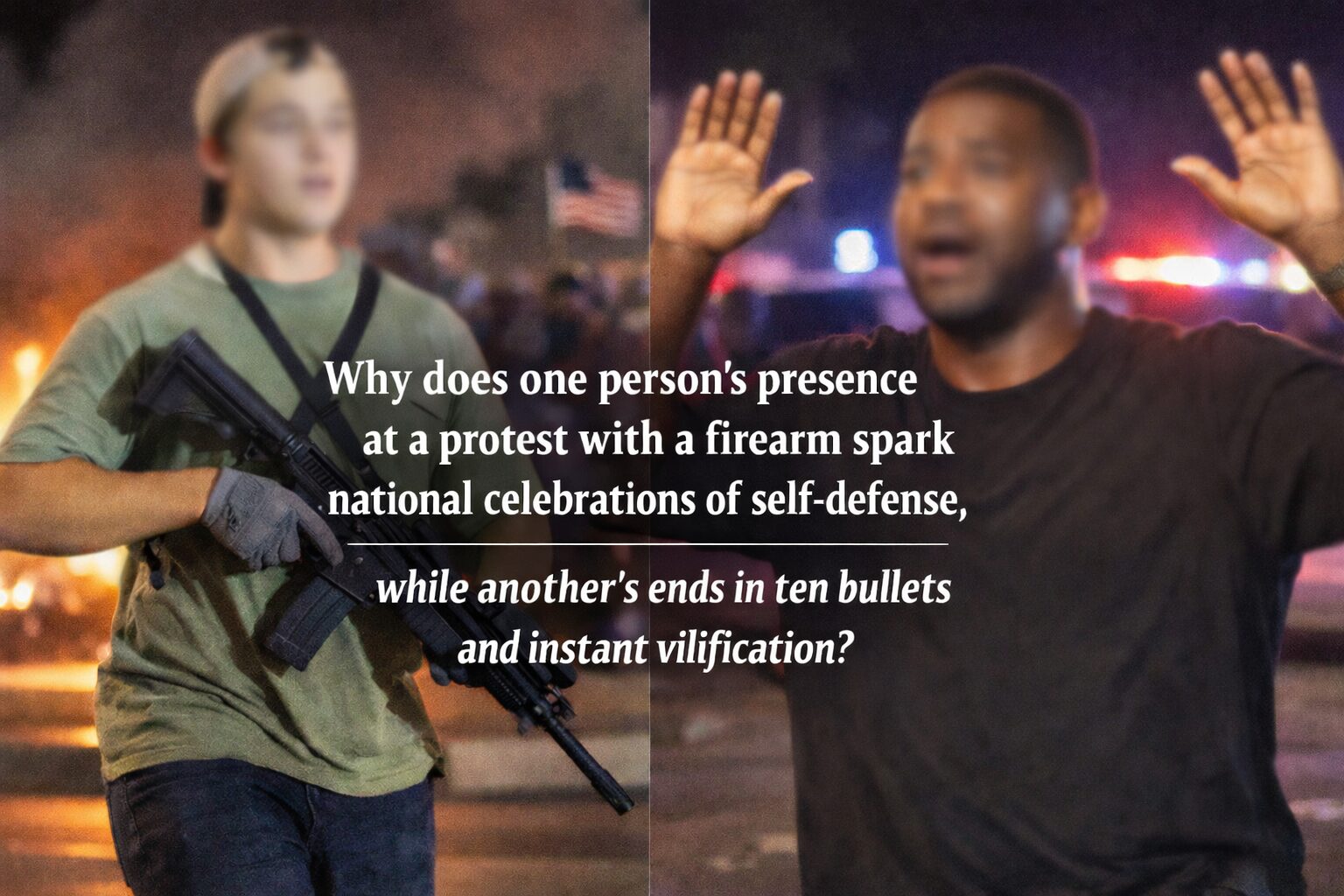
That’s the uncomfortable question burning through social media after Kyle Rittenhouse decided to weigh in on the shooting death of Alex Pretti, a 37-year-old ICU nurse killed by federal agents in Minneapolis last month. Pretti wasn’t some outsider looking for confrontation—he was a Department of Veterans Affairs nurse who lived in the city, held a legal permit for his handgun, and was reportedly trying to help a woman who’d been pushed to the ground by ICE agents when he was pepper-sprayed, swarmed by at least five officers, and shot dead in roughly five seconds.
Video analysis from multiple news outlets shows Pretti holding his cell phone, not a weapon, in his final moments. He never drew his firearm. He never aimed it. Yet administration officials immediately branded him a “domestic terrorist,” a “would-be assassin,” and an “insurrectionist” before any facts emerged.
Does this sound familiar?
In 2020, Kyle Rittenhouse crossed state lines to Kenosha, Wisconsin, armed with an AR-15, and killed two people while claiming self-defense. He wasn’t from the community. He wasn’t a healthcare worker. He was a teenager who decided to play protector in a city where he didn’t live. A jury acquitted him, and he became a conservative folk hero, a symbol of Second Amendment rights and “standing your ground.”
So when Rittenhouse took to social media to complain that Pretti was receiving preferential treatment, the contradiction was almost too blatant to believe. “For years, I’ve been told that I ‘should’ve stayed home’ during the Kenosha riots,” he wrote. “Very ironic Pretti isn’t held to the same standard… because he’s their fellow comrade.”
But shouldn’t the standard actually be reversed? Pretti didn’t kill anyone. He didn’t wound a third person. He didn’t become a media sensation or a mascot for any political movement. He was simply a nurse in his own neighborhood who ended up dead. Why does Rittenhouse believe he is the victim in this comparison?
The online response was immediate and fierce. Critics pointed out that Pretti didn’t travel across state lines armed for combat, didn’t shoot three people, and didn’t leverage his situation into a political career. “You should have stayed home because you’re a psychopath,” one commenter wrote. Others called Rittenhouse “a prop” and “too stupid to know it.”
And what about the highest office in the land? President Trump, who had recently called for “de-escalation” in Minnesota, took to Truth Social to declare that Pretti’s “stock has gone way down” after video surfaced showing him kicking an ICE vehicle eleven days before his death. He labeled the slain nurse an “agitator and, perhaps, insurrectionist,” praising the agents involved as “very calm and cool.”
This is the same president who has described January 6th rioters as patriots and victims of persecution. The same administration that initially claimed Pretti fired on agents before being forced to retract that statement when video evidence proved otherwise.
So where is the line between patriot and threat, between legitimate protest and dangerous insurrection? Does it depend on which side of the political spectrum you fall? Does it depend on your race, your profession, or whether you’re carrying a cell phone versus an assault rifle?
The Trump administration has partially retreated from its most inflammatory rhetoric, calling Pretti’s death “very unfortunate” and removing a confrontational Border Patrol commander from the Minneapolis operation. The Department of Justice has opened a civil rights investigation. Senator Rand Paul, a Republican, is demanding testimony from ICE leadership.
But two American citizens—Renee Good and Alex Pretti—are dead in Minneapolis at the hands of federal agents within seventeen days. Both were initially portrayed as threats. Both were, in the end, unarmed in any practical sense when they were killed.
So here’s what America must ask itself: If Alex Pretti had been a young man with an AR-15 “protecting” a neighborhood he didn’t belong to, would conservative media be calling him a hero instead of a terrorist? And why does Kyle Rittenhouse, who actually took two lives, believe he has the moral standing to criticize a dead man who took none?


Leave an answer