
When a Medical Examiner Rules Homicide, Why Does ICE Call It “Medical Distress”?
Question
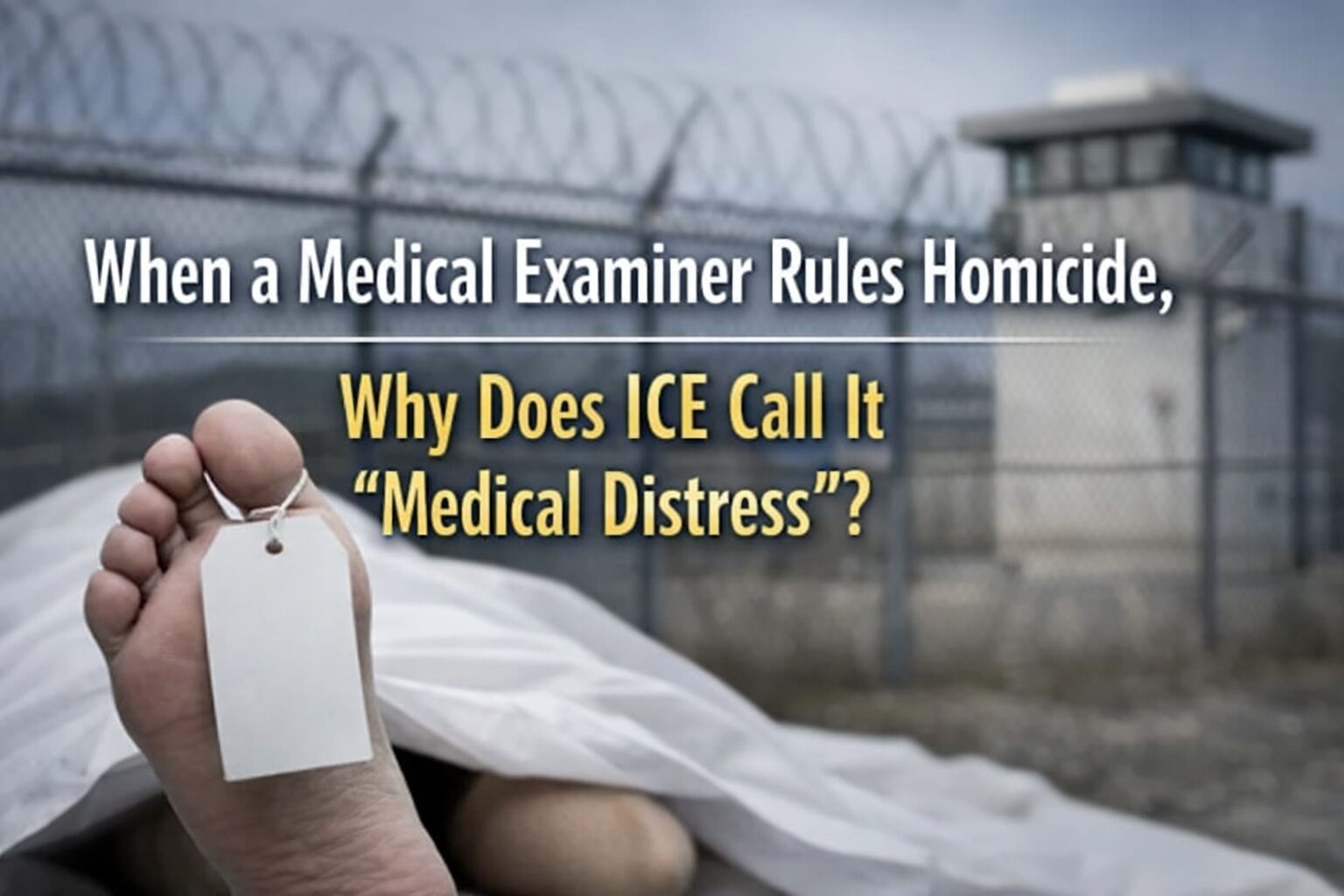
What happens when the story of a man’s final breath gets edited after the fact? On January 3, Geraldo Lunas Campos stopped breathing inside a canvas-walled city at Fort Bliss, Texas. The El Paso Medical Examiner later measured the weight on his neck and chest and wrote one word: homicide. ICE’s press release, meantime, measured the political temperature and wrote two: medical distress. Which version do you trust—the one on the autopsy slab or the one with a $8 billion budget?
How does a 55-year-old father of four die from “asphyxia due to neck and torso compression” while under physical restraint by law enforcement? Who placed that pressure? Whose knee, whose elbow, whose body weight? And why, when a daughter’s secret recording reached the Washington Post, did ICE’s narrative suddenly pivot from vague illness to suicide? If the victim tried to end his own life, does that justify the compression that ended it instead? When does a “rescue” become a homicide?
What kind of system builds a tent camp for 5,000 human beings on an Army base in the desert? Camp East Montana sprouted last summer—not as a shelter, but as a warehouse for the collateral damage of a political promise. Inside, mental illness becomes a footnote: Lunas Campos had bipolar disorder and anxiety. Outside, criminal history becomes a shield against empathy: he was a registered sex offender, convicted felon, ordered deported in 2005. The government couldn’t get travel documents then; they got a bed in El Paso now. Is justice delayed somehow more fatal than justice denied?
Who counts the dead when the counting is done by the same agency that stocked the morgue? Lunas Campos is the third body at Camp East Montana. Third. Francisco Gaspar-Andres, 48, from Guatemala, died December 3—liver and kidney failure, ICE claims, autopsy still floating in bureaucratic limbo. Victor Manuel Diaz, 34, from Nicaragua, found “unconscious and unresponsive” January 14, maybe suicide, maybe something else. And 48 hours after Lunas Campos was crushed, Luis Gustavo Núñez, 42, from Honduras, collapsed from “chronic heart issues” near Houston. Four deaths in Texas detention in two months. Three under the same tent roofs. Is this a statistical cluster or a design feature?
What do we call it when the architecture of detention becomes the architecture of death? The camp holds 5,000, but capacity isn’t just beds—it’s breaths. It’s the number of people who can be rendered invisible before one becomes indelible. Lunas Campos lived in Rochester, New York, for nearly two decades. He was arrested in July 2025 and shipped 2,100 miles from home to a tent where the desert wind whispers through canvas. Does distance from community make death more administratively convenient?
Why does a medical examiner’s truth need a daughter’s leaked recording to reach daylight? The state performs autopsies; the state also issues press releases. When those narratives diverge, who decides which story the public hears? And what does it cost a daughter to become the conduit of truth about her father’s compressed throat?
When we debate immigration policy, are we avoiding the simpler question: How many homicides is a deportation order worth? A 2005 removal order, unexecuted for two decades because paperwork failed, somehow justified a fatal restraint in 2025. Is this efficiency, or is this vengeance for bureaucratic embarrassment?
What will it take for “homicide” to trend more than “criminal alien”? For “compression” to outrage more than “convicted felon”? The autopsy report is public. The press release is public. The gap between them is where accountability suffocates. Who will apply pressure to the system’s neck until it, too, becomes unresponsive?
How many more names must be carved into the desert sand before the tents come down?


Leave an answer