
Can a Federal Judge Force a Top ICE Official into Contempt? One Judge Just Ordered Him to Court to Answer.
Question
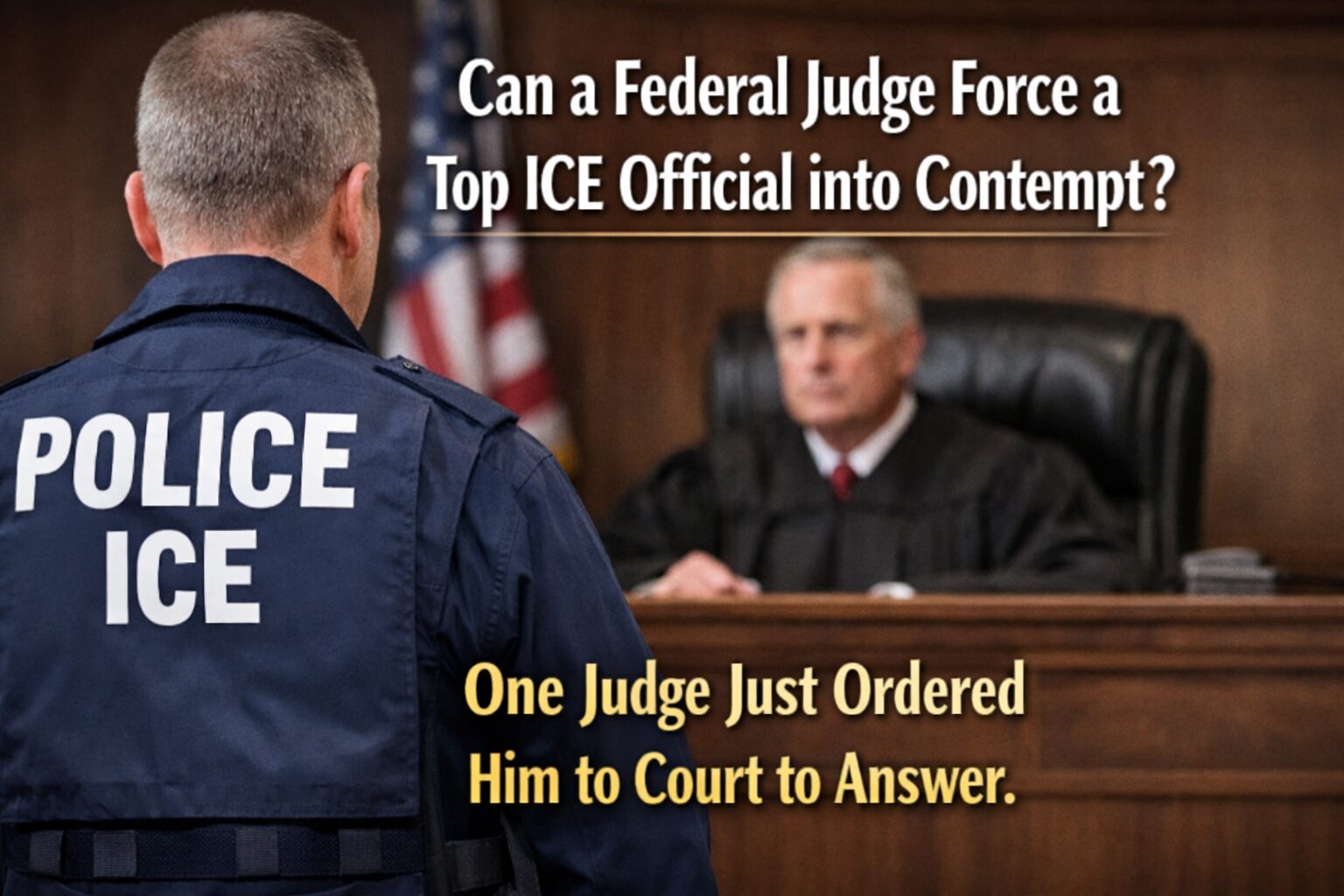
A tense legal showdown is unfolding in a Minneapolis courtroom that asks a fundamental question about power in America: What happens when a federal law enforcement agency repeatedly ignores the orders of a federal judge?
The answer is now taking shape in a dramatic, three-page judicial order. U.S. District Court Chief Judge Patrick Schiltz has demanded that Todd Lyons, the Acting Director of U.S. Immigration and Customs Enforcement (ICE), personally stand before him this Friday. The purpose: for Lyons to explain why he should not be held in contempt of court.
The judge’s language is unequivocal and exhausted. “This Court’s patience is at an end,” he wrote, detailing what he calls ICE’s failure to comply with “dozens” of recent court orders. The immediate case involves a single detained immigrant who was granted a bond hearing by judicial order last week but remains in custody. But the judge frames it as a pattern of systemic disregard.
“This is an extraordinary step,” Judge Schiltz acknowledged. “But the extent of ICE’s violation of court orders is likewise extraordinary.”
The order forces us to confront several urgent questions:
Who ultimately enforces the rules when the enforcers break them?
Judge Schiltz described a cycle of broken promises, noting that ICE and the Department of Homeland Security have “continually assured the Court” of their compliance, only for the violations to persist. The consequences, he wrote, are severe for individuals—extended detention, sudden transfers across the country, and lives upended.
Is personal accountability the only remedy for institutional failure?
By summoning the agency’s top official, the judge is shifting focus from bureaucratic excuses to direct, personal responsibility. He offered a clear path to avoid the hearing: release the detained individual in question. Otherwise, the boss must answer directly to the bench.
Does this judicial fury exist in a vacuum?
While the contempt threat is strictly about defied court orders, it lands in a Minnesota community already on edge. Recent, unrelated fatal shootings of U.S. citizens by federal agents have ignited protests and deepened scrutiny of federal enforcement tactics. The judge’s order amplifies a crescendo of demand for accountability.
The Friday hearing is now a pivotal test. It probes the limits of judicial authority and the obligations of executive power. If a judge’s order can be ignored without consequence, what is the foundation of the rule of law? Judge Schiltz is compelling the head of ICE—and the public—to consider the answer.


Leave an answer