
Who Gets Arrested on Christmas Morning? In the Florida Keys, the Answer Is: Everyone
Question
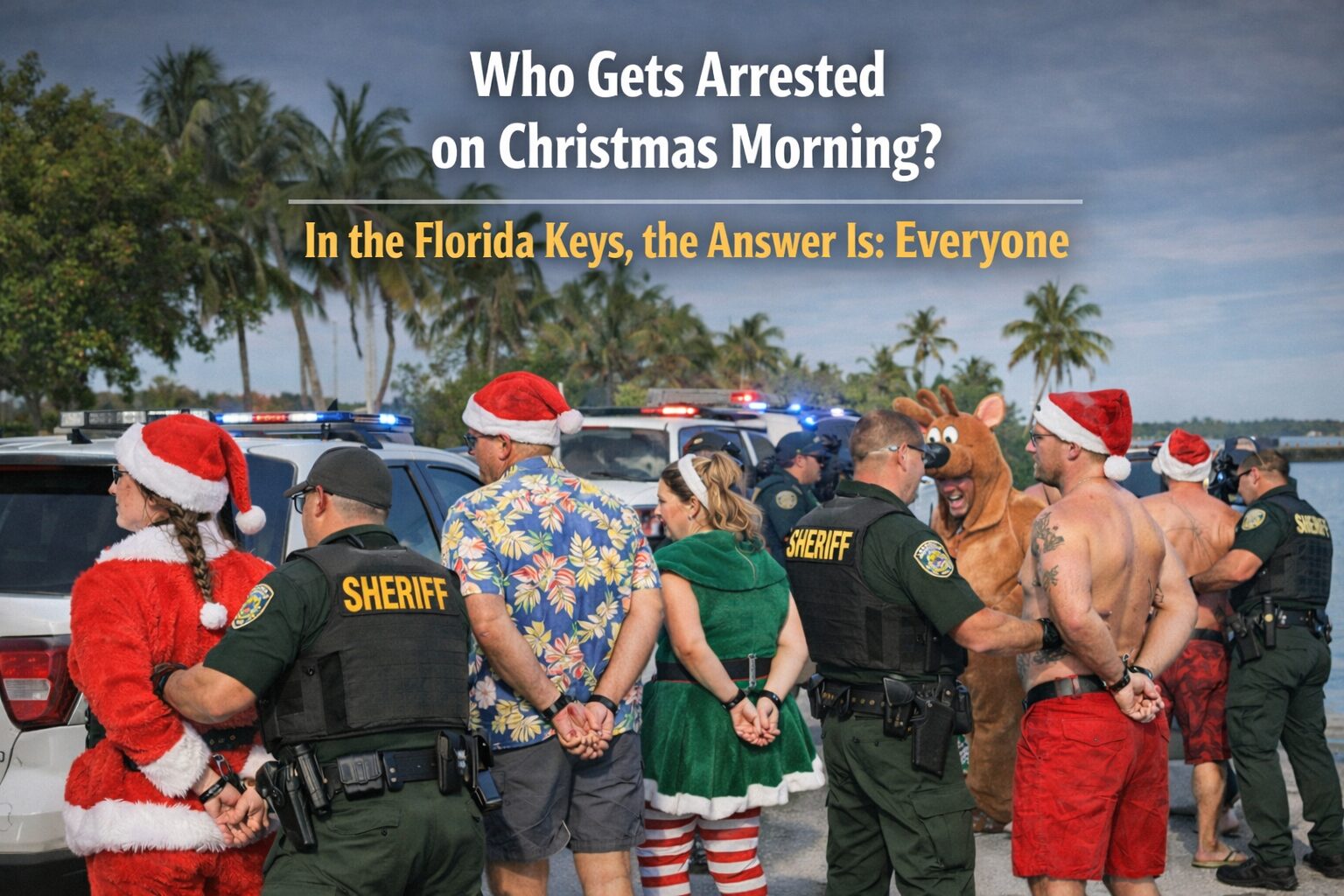
Was Rhonda Stanfill’s stocking filled with coal—or criminal charges? Inside the holiday sting that’s turning paradise into a 24/7 police operation
What does it take for law enforcement to slap handcuffs on someone while kids are unwrapping presents? In Monroe County, Florida, it takes a months-long narcotics probe, a multi-agency task force, and an alleged cocaine deal that couldn’t wait until Boxing Day.
Rhonda Merle Stanfill, 44, found out the hard way that Christmas isn’t a get-out-of-jail-free card. Detectives from the Monroe County Sheriff’s Office Special Operations Division arrested her December 25 at her Big Coppitt Key residence, charging her with selling cocaine and peddling hydrocodone-acetaminophen. Her holiday gift? A $75,000 bond and a cot at the county detention center.
Why Didn’t Police Just Wait Until December 26?
Could they have postponed the arrest? Sure. But here’s the uncomfortable truth: drug investigations don’t come with pause buttons. Task force commanders argue that waiting gives suspects time to destroy evidence, flee, or make another sale. When fentanyl’s involved—a drug so potent it can kill in micrograms—every hour matters.
“This investigation has been active through weekends, nights, and every major holiday,” a Sheriff’s Office spokesperson confirmed. “We can’t put community safety on a calendar.”
The operation, targeting fentanyl and cocaine distribution in the Lower Keys, has been grinding for months. Stock Island and Key West sit at the epicenter, locations investigators describe as persistent, open-air drug markets where deals happen in parking lots, behind bars, and sometimes in broad daylight.
How Do You Run a Drug Ring on a 113-Mile Dead-End Road?
Isn’t it hard to smuggle anything into the Keys? After all, there’s literally one road in and one road out—the Overseas Highway, where a traffic jam can back up for miles and every vehicle passes through a toll booth. So how are dealers moving product?
The answer isn’t on asphalt—it’s on water. The same Atlantic and Gulf waters that draw fishing charters and sunset cruises are allegedly being used for “go-fast” boat runs from international waters. A waterproof package, a remote GPS drop point, and the pipeline stays flowing. Local dealers act as middlemen, while the area’s transient workforce—seasonal bartenders, boat crews, vacationing snowbirds—provides perfect cover.
What makes the Keys a cartel sweet spot? Geography. Remote enough to avoid big-city scrutiny, wealthy enough to support high prices, and nautical enough to make smuggling a lifestyle.
What Makes One Suspect Worth a $330,000 Bond?
Why does Damonta Derek Knowles’s bond cost more than a beachfront condo? The 39-year-old Key West resident faces charges of selling fentanyl and cocaine within 1,000 feet of a restricted area—Florida law’s designation for schools, parks, and churches. Prosecutors allege he used a two-way communication device to coordinate sales, a felony enhancement that screams “organized operation.”
Knowles isn’t alone in the high-stakes lineup:
- Humberto Hernandez, 65 – $240,000 bond for cocaine sales and using a communication device.
- Robert Lee Brown, 50 – $150,000 bond for cocaine distribution.
- Zoryana Erica Brown, 28 – $130,000 bond for cocaine and felony device use.
- Isidro Fernandez, 40 – $50,000 bond for cocaine sales.
- Lourdes Nodal Santana, 59 – $50,000 bond for cocaine sales.
- Jasmine Isabel Maisonet, 43 – Wanted on warrant for fentanyl sales near a restricted area, $25,000 bond.
The bond amounts aren’t random. They’re calculated based on criminal history, flight risk, and—crucially—whether the alleged sale happened near kids. Sell near a school, and your bail skyrockets. The message: poison the community, pay the premium.
Why Is Fentanyl the Real Ghost of Christmas Future?
What’s scarier than cocaine? A drug 50 times stronger than heroin that’s showing up in counterfeit pills across the Keys. Fentanyl is cheap to produce, easy to hide, and frequently mixed into fake OxyContin or Xanax without users knowing. The result? Overdose deaths have risen since 2020, with fentanyl present in 73% of cases in Monroe County.
How does that translate to real families? It means a teenager buying what they think is a prescription painkiller can die in minutes. It means paramedics carry Narcan like fishermen carry bait. It means every arrest might have saved a life—or come too late for someone else.
“Fentanyl doesn’t care about your zip code,” a local addiction counselor notes. “It’s in Big Pine, it’s in Marathon, it’s on Duval Street. The Keys’ isolation actually makes it worse—help is farther away.”
Who’s Actually Running This Show?
Is this just a local sheriff flexing? Hardly. The task force is a federal-local hybrid beast: Monroe County Sheriff’s Office, Key West Police Department, DEA, Homeland Security Investigations, and U.S. Customs and Border Protection. That’s not a neighborhood watch—that’s a full-court press.
Why so many agencies? DEA brings wiretap expertise and cartel intel. Homeland Security tracks cross-border movements. Customs monitors maritime traffic. Local cops know the players, the slang, and which docks have suspicious traffic at 3 a.m.
The cooperation has allowed investigators to move up the food chain, from street dealers to distributors. They’re building conspiracy cases, which means RICO charges could turn 5-year sentences into 25-year prison terms.
How Many More Christmases Will Be Like This?
Is the investigation wrapping up? Not even close. Commanders have explicitly warned: more arrests are coming. Detectives are still analyzing phone data, flipping lower-level suspects, and preparing warrants. New Year’s, Valentine’s Day, Memorial Day—every holiday is just another workday.
The goal isn’t just to fill jail cells. It’s to choke off the supply of fentanyl and cocaine flowing into residential neighborhoods and near restricted zones. But here’s the paradox: every arrest creates a vacuum, and vacuums get filled. The war on drugs is less a war and more a never-ending game of whack-a-mole.
What Can Regular People Actually Do?
Should residents just lock their doors and hope? Absolutely not. Law enforcement insists community tips are the secret weapon. That Airbnb with endless 2 a.m. visitors? The boat that only departs after midnight? The “fisherman” who never catches fish? Those observations matter.
Monroe County Crime Stoppers reports that 40% of drug warrants stem from civilian calls. Tips can be anonymous and potentially reward up to $1,000. More importantly, they provide patterns detectives can’t see from a patrol car.
But there’s a deeper question: Is reporting enough? Or does the Keys’ identity—tourism-dependent, party-friendly, live-and-let-live—make it culturally resistant to the kind of zero-tolerance approach law enforcement is pushing?
Is Paradise Worth the Price?
What’s the real cost of living in a tropical dreamscape? The Keys sell an image: Duval Street debauchery, Ernest Hemingway’s polydactyl cats, sunset sails with champagne. But that image depends on ignoring the pipeline of poison running beneath it.
Every $330,000 bond, every Christmas Day arrest, every Narcan deployment is a reminder: paradise has a tax. And it’s not paid in property assessments or tourist fees. It’s paid in lives, in closed-casket funerals, in parents who bury their children because a pill looked real.
So who gets arrested on Christmas morning? In the Florida Keys, it’s someone who allegedly chose profit over community. It’s someone who, knowingly or not, participated in a system that’s killing people. And it’s someone who learned, too late, that law enforcement doesn’t take holidays when the product is fentanyl.
The investigation continues. The next knock might be New Year’s Day. Will anyone be surprised?


Leave an answer