
What If New York’s Hudson River Is Still Ruled by an Ancient Goblin King?
Question
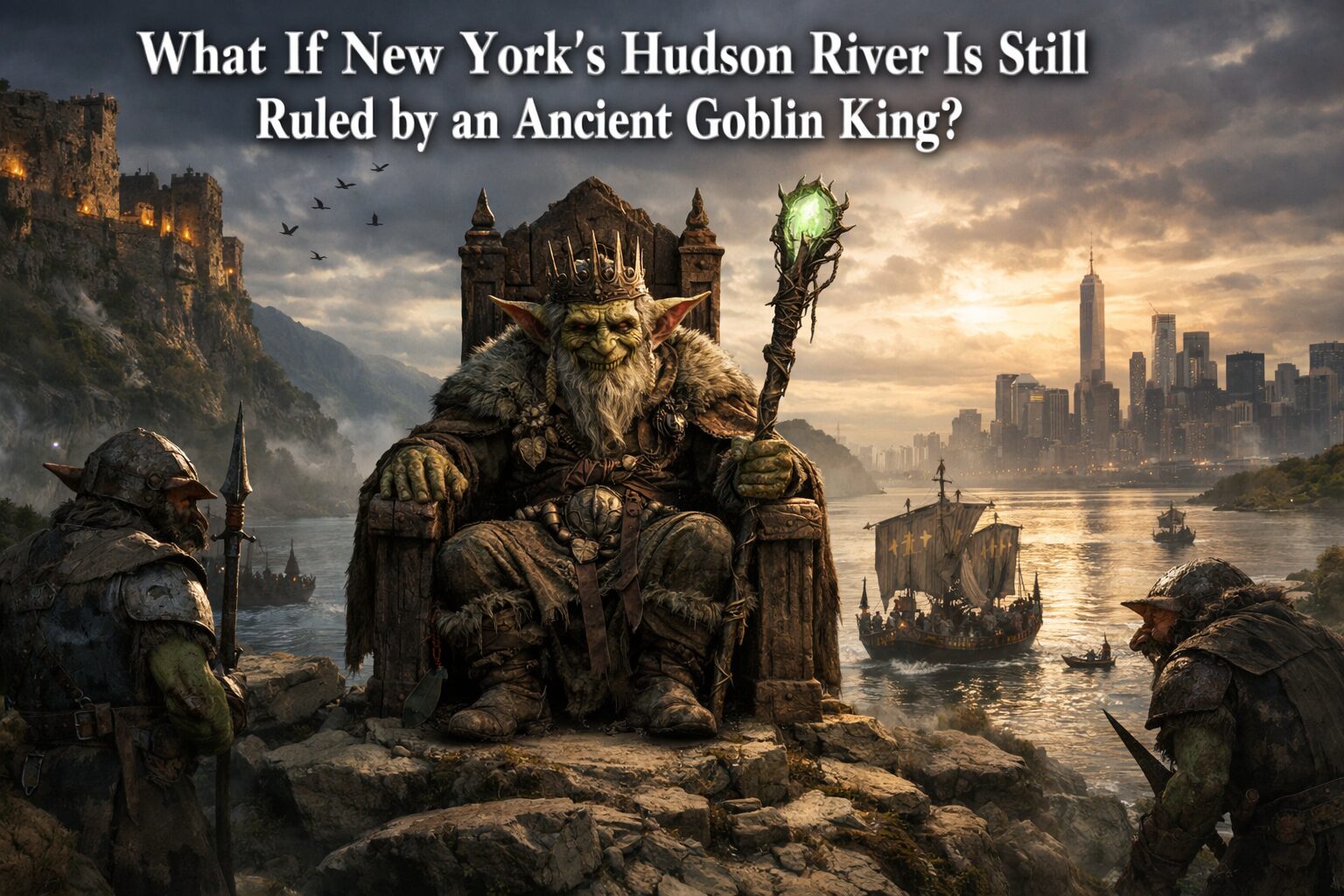
Is it possible that every storm in the Hudson Valley has a supernatural conductor? I’ve lived along the Capital Region’s stretch of the Hudson for years, watching weather roll down from the Adirondacks with theatrical fury. But after diving into forgotten Dutch maritime logs, I have to ask: when thunder cracks against those granite cliffs, are we hearing nature—or commands from a deposed monarch of chaos?
Did Henry Hudson’s Crew Encounter Something Beyond a Storm?
Picture September 1609: Hudson’s Half Moon navigates the treacherous Hudson Highlands, where mile-high walls of stone turn the river into a gauntlet. The sky curdles black. Winds shriek with voices. Waves rise like clutching hands. To modern minds, this is a perfect meteorological storm. But to Dutch sailors, it was the Heer of Dunderberg—the King of Thunder Mountain—announcing his displeasure.
They described him in unsettling detail: a round, impish figure in Dutch breeches, sugar-loaf hat perched on his head, blasting orders through a trumpet to legions of subservient goblins. Why would experienced mariners invent such a specific antagonist? Was it simply homesickness and fear, or something about those narrows that defied rational explanation? Having kayaked those same waters during a sudden squall, where the cliffs turn every sound into a chorus of screams, I understand why they didn’t reach for scientific terms—they reached for spiritual ones.
Why Did an Entire Island Become “Uninhabitable” by Natives and Sailors Alike?
The Heer’s supposed kingdom was Pollepel Island, now known as Bannerman Island. Before Francis Bannerman built his Scottish castle there in 1901, indigenous tribes refused to set foot on it. They claimed it was possessed by evil spirits, a place where the land itself rejected human presence. The Dutch heard these warnings and wove them into their own mythology: a tribe of goblins headquartered here, launching weather attacks on passing ships.
What makes this island so narratively durable? Bannerman Castle Trust’s official history calls these “fanciful tales,” yet they’ve persisted for four centuries. When I toured the island last summer, our guide joked about “checking for goblins in the ruins.” The crowd chuckled—until afternoon clouds cast shadows through collapsed turrets that looked suspiciously like figures watching us. The Trust recently posted on Facebook: “There are NO GOBLINS on the island.” But isn’t that exactly what you’d say if managing a public relations nightmare with the underworld?
How Did Washington Irving Turn Sailor Gossip Into Immortal Terror?
Why does every great American ghost story seem to flow through Washington Irving? The Sleepy Hollow author didn’t create the Heer of Dunderberg, but he weaponized him. In his lesser-known work “The Storm Ship,” Irving fused the goblin king with the Flying Dutchman, damning a ghost vessel to sail Hudson waters eternally. His version placed the ship’s sinking just south of Bannerman Island, where “during violent storms, cries for help from the crew can still be heard.”
Irving understood that the Hudson Valley’s beauty is inseparable from its darkness. He transformed Dutch superstition into literature, embedding the legend into regional identity. But here’s the question that keeps me up: Did Irving write fiction, or document phenomena that locals already believed? His genius was making the legend self-perpetuating, ensuring each generation would rediscover and adapt it.
Are People Still Witnessing the Impossible Today?
If the Heer is just folklore, why do sightings persist? In 1976—centuries after Hudson—multiple witnesses reported a “turtle-shaped” UFO hovering over the Tappan Zee Bridge approach (now the Governor Mario M. Cuomo Bridge). Police confirmed it. Firefighters chalked it up to balloons, but witnesses described intentional movement: hovering 5-10 minutes before ascending eastward.
What attracts anomalies to this specific corridor? Is it the same geological or electromagnetic characteristics that made Dutch sailors sense malevolence? Modern paranormal investigators point to ley lines and energy vortices. Scientists might cite atmospheric conditions created by the Highlands’ unique topography. Both theories attempt to rationalize why, in 2024, Bannerman Island’s Facebook page still needs to actively dispel “goblin rumors” after visitors post photos of strange lights near castle walls.
What Else Lurks in the River’s Shadow?
The goblin king is merely the opening act. Why is the Hudson Valley America’s most concentrated zone of authenticated paranormal activity? Albany Rural Cemetery—resting place of President Chester A. Arthur—has countless reports of phantom children playing among 1840s headstones. Vale Cemetery in Schenectady sees mourners touched by invisible hands near the 1865 “Stranger’s Burial Ground.”
Even Storm King Mountain itself perpetuates the legend. Every thunderstorm that lashes its slopes is, according to local oral tradition, the Heer throwing a meteorological tantrum. Are we naming geographical features after folklore, or are we acknowledging what earlier residents actually experienced? The line between metaphor and memory blurs with each retelling.
Why Do We Desperately Need These Stories to Be True?
Here’s the uncomfortable question: In our age of GPS and weather satellites, why do we cling to goblin kings? Perhaps it’s because the Hudson River isn’t just water and silt—it’s a 315-mile question mark connecting wilderness to metropolis, carrying four centuries of unanswered screams in its current.
The legend endures because it performs what all great folklore accomplishes: it cautions (stay away from dangerous waters), it explains (why storms behave so strangely here), and it entertains. But deeper than that, the Heer of Dunderberg represents something we’ve lost—genuine uncertainty. When every mystery is solvable via smartphone, the idea that some waters are simply unknowable becomes precious.
Does the King Still Reign?
So I ask you: the next time you’re crossing the river and the sky darkens with unnatural speed, when the wind howls through the Highlands with a voice that sounds almost human, are you just experiencing weather? Or are you hearing echoes of a kingdom that never truly fell?
The Dutch sailors processing terror, Irving documenting psychic landscapes, 1970s witnesses describing UFOs, and you feeling watched on a lonely stretch of riverbank—you’re all connected by a story that refuses to die because some part of it might be stubbornly, inconveniently, true.


Leave an answer