
What Happens When “Temporary” Ends? America’s Somali Community Faces a March 17 Reckoning.
Question
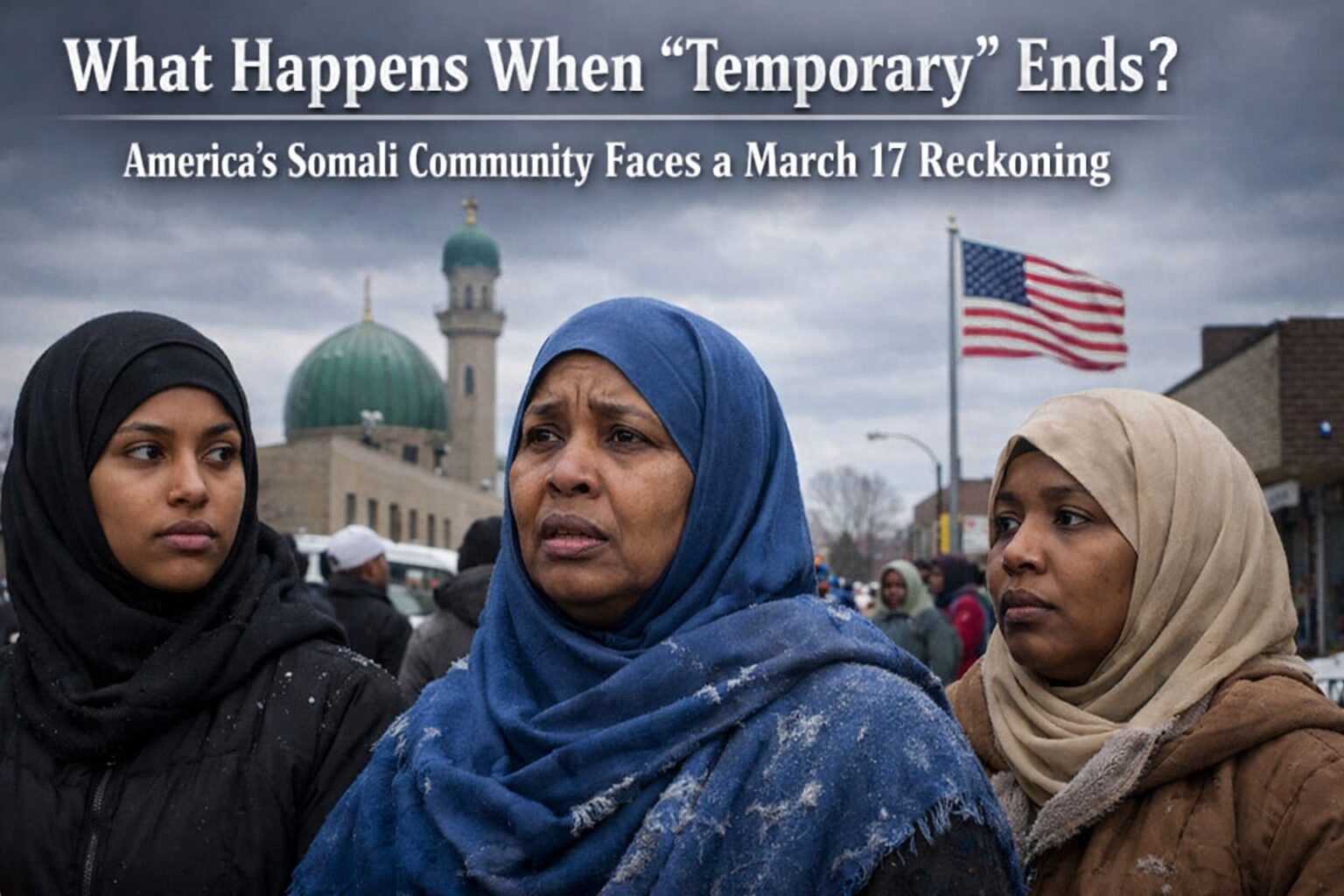
Imagine building a life in the only country your children have ever known. You pay taxes, work a job, and contribute to your community. Then, a letter arrives: the legal status that allowed you to live and work here peacefully will vanish on a specific date. After that, you become eligible for deportation.
This is not a hypothetical scenario. For approximately 2,500 Somali nationals living in the United States under Temporary Protected Status (TPS), this is their reality as of March 17. The Trump administration’s decision to terminate Somalia’s TPS designation has thrown an entire community into profound uncertainty.
But this move forces us to ask a deeper, more uncomfortable question: When does a “temporary” refuge become a permanent home, and what do we owe the people who built lives in that interim?
The Department of Homeland Security’s stance is unequivocal. “Temporary means temporary,” declared Secretary Kristi Noem. The administration argues that conditions in Somalia have improved enough that the humanitarian justification for TPS no longer exists, and that continuing the program is “contrary to our national interests.”
The policy echoes President Trump’s longstanding and often inflammatory rhetoric about Somali immigrants. Behind closed doors, he has reportedly labeled them as undesirable, framing their removal as a patriotic necessity. This termination is part of a sweeping effort to roll back TPS for dozens of countries, reversing expansions made under the prior administration.
Yet, critics fire back with questions of their own: Have conditions in Somalia truly stabilized enough to force the return of thousands? The nation still grapples with terrorism, political instability, and famine. Is it truly in America’s “national interest” to uproot families, many of whom have U.S.-citizen children, and destabilize communities where they are integrated?
The human impact is concentrated in places like Minnesota, which hosts the largest Somali diaspora in America. There, the termination of TPS isn’t a political abstraction; it’s neighbors, coworkers, and small business owners facing an impossible choice. The administration’s parallel surge of ICE agents in the region, justified by citing isolated fraud cases, has already sown fear and sparked protests, most notably after a controversial ICE-involved shooting in January.
So, as the clock ticks down to March 17, we are left with the most poignant question of all: What is the legacy of a humanitarian program that offers safe harbor, allows roots to grow, and then demands they be severed? The story of these 2,500 Somalis is a test case for how America defines compassion, consistency, and what it truly means to put “Americans first” when so many of those affected have spent decades becoming just that.


Leave an answer