
What Happens When Climate Change Crashes Your Christmas?
Question
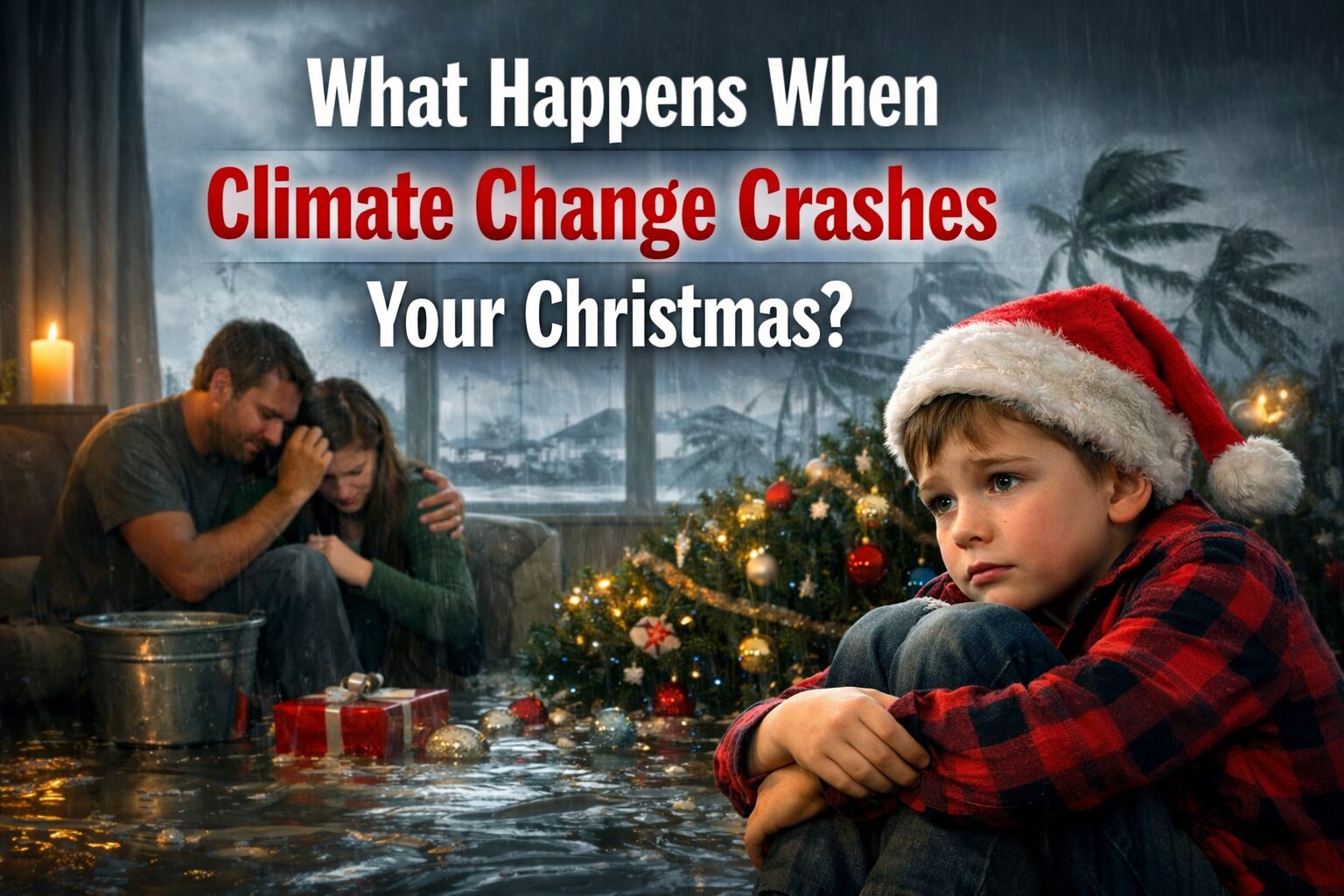
How did a record-shattering storm transform California’s holiday dream into a survival nightmare—and what does it mean for your future?
Could This Be The Christmas That Changed Everything?
What if Santa’s sleigh couldn’t land because the runway was underwater? What if your holiday feast depended on whether power crews could restore electricity before your 99-year-old mother arrived? These weren’t hypothetical questions for millions of Californians who watched Christmas evaporate under a deluge that rewrote record books and redefined “extreme weather.”
How much rain does it take to break a city? Santa Barbara discovered the answer when over three inches fell on Christmas Eve—shattering a daily record and drowning the airport. How fast can a highway become a river? Interstate 5 in the San Fernando Valley flooded overnight, turning America’s West Coast artery into a temporary canal. What does 160,000 homes without power look like? Picture Christmas morning without lights, heat, or the ability to cook that expensive turkey.
But here’s the question that should chill everyone: Was this just a fluke, or a preview of our new holiday normal?
What Does Apocalypse Look Like? Ask Wrightwood.
Why would helicopters land on rooftops in a quiet ski town? Because Wrightwood—population 5,000—was drowning in mud, not snow. How much destruction can one storm deliver? Enough to bury homes under five feet of debris, wash away bridges, and trap residents in 44-degree cabins with only fireplaces for warmth.
Who spends Christmas huddled with their dogs for survival? Chris Reid, a 54-year-old contractor, whose text messages became a lifeline: “We’re snuggling with our three dogs at night to keep warm.” How long does it take to rebuild a destroyed community? Power companies told Wrightwood residents they’d spend the next week in darkness—minimum.
What does it take to evacuate a mountain town during Christmas dinner? Fire Chief Daniel R. Munsey described the impossible: crews racing through mudflows, laying sandbags against an ocean of debris, and airlifting horses from flooded stables. “You’re not going to be able to move into these houses anytime soon,” he told shell-shocked residents. How do you celebrate Christmas when your home becomes a mud-filled bunker?
Who Else Was Fighting For Survival?
Where do 72,000 people spend Christmas night when the grid fails them? Scattered across Northern California and mountain regions, they became a constellation of generators and candlelight. Who charges their phone in a car on Christmas? The Malibu fire refugees across the street from Linda Mendez, who’d already lost one home to January’s inferno and now faced their second disaster in a year.
How old is too old to lose Christmas? Ninety-nine-year-old matriarch almost did, until power returned to Woodland Hills just before noon. “We’re going to see what we can salvage for dinner after I mop up the water leaking out of the refrigerator,” her daughter texted. Who deserves this kind of holiday?
What kills during a rainstorm besides flooding? In San Diego, a tree branch—loosened by rain-soaked soil—crushed someone Thursday, a freak death that raises the question: How many ways can a climate-intensified storm end your life?
Why Is This Happening Now—And Why So Violently?
What’s an atmospheric river? Nothing less than a firehose of Pacific moisture that’s been aimed at California for a week straight. But here’s the more disturbing question: Why are they getting worse?
How does climate change turn rain into a weapon? Simple physics: A warmer atmosphere holds more water vapor—7% more for every degree Celsius of warming. So when storms hit, they’re not just wetter; they’re weaponized. What used to be a 100-year storm now arrives every few years. How many “historic” weather events can one state endure before the history books stop counting?
What happens when record rainfall hits record rainfall? Los Angeles and Burbank shattered their Christmas Eve records, then faced an additional 1.5 inches Thursday night. Why does this matter? Because even “moderate” rain on supersaturated ground creates mudslides that erase neighborhoods. Will fire-scarred hills ever stabilize, or will they keep collapsing with every storm?
What Were Officials Saying While the Sky Fell?
Did government warnings save lives? Mayor Karen Bass didn’t hedge: “I am urging all Angelenos to stay safe and be extremely careful on the roads if you absolutely must travel. Please do not take this storm lightly.” How many people listened? Enough to prevent mass casualties—but not enough to empty the danger zones completely.
Who decides which neighborhoods must evacuate on Christmas? Emergency managers ordered mandatory evacuations across Orange, Ventura, Los Angeles, and San Bernardino Counties. Governor Gavin Newsom declared emergencies in six counties—did your county make the list?
What areas remain in the crosshairs? Three zones near January’s burn scars still face evacuation warnings. How do you pack for Christmas when you’re on notice to flee at any moment?
When Will It End—And What Comes Next?
How much more can California take? The second wave arrived Thursday night as predicted, dumping another 1.5 inches on LA and 3+ inches in mountains through Friday noon. Which regions face the biggest risk? Coastal ranges like the Santa Cruz and Diablo mountains could see localized cloudbursts that turn streets into rivers in minutes.
Will the weather ever show mercy? Forecasts finally promise sunshine beyond Friday—but what about the next atmospheric river? And the one after that?
What Is This Christmas Trying To Tell Us?
What do you remember about Christmas 2024? For thousands, it won’t be presents or dinner. It’ll be the sound of helicopters on their roof. The feeling of mud seeping through their walls. The sight of their neighbors charging phones in cars because home doesn’t feel safe anymore.
How many times can you rebuild before you start asking different questions? The Malibu fire refugees in Woodland Hills lost everything once. Now they’re underwater. What’s the language of climate change if not this: First fire, then flood. First evacuation, then another.
What does “significant infrastructure impacts” really mean? It means bridges gone. Roads erased. Power lines that won’t be fixed for weeks. It means a ski town that may not recover before the snow melts. It means your tax dollars can’t keep up with your weather.
So What’s The Question We Should All Be Asking?
Is this California’s future? Is it yours? When atmospheric rivers become atmospheric highways, when Christmas requires evacuation orders, when 99-year-old mothers might not get their dinner—what exactly are we celebrating?
The storm is over. The questions are just beginning.


Leave an answer