
What Happens When a College Access Warrior Takes Over a School That Already Defies the Odds?
Question
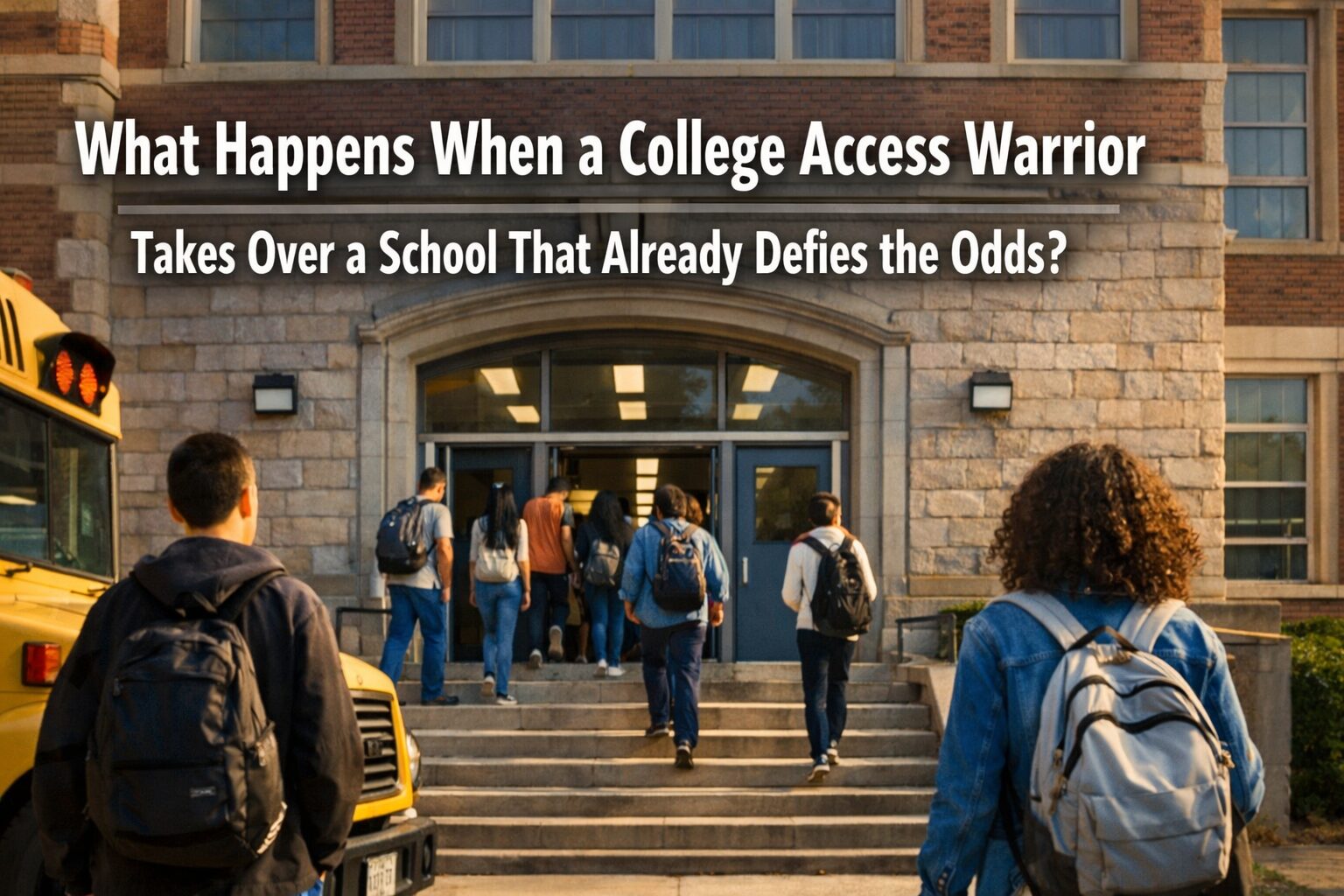
Can one leader’s lifetime of breaking barriers for first-generation students supercharge a middle school that already graduates 95% of its boys?
What’s the Real Story Behind This Quiet Wilmington School?
Tucked inside Wilmington’s most challenging neighborhoods sits an educational outlier: Nativity Preparatory School, where boys attend classes for free, stay late into the evening, show up during summer break, and somehow beat every statistical prediction scripted for them before birth. Founded in 2003, this Catholic middle school—open to all faiths—operates on a simple but radical premise: poverty isn’t a learning disability, it’s a logistics problem that can be solved with longer school days, smaller classes, and a promise that doesn’t expire at graduation.
The numbers seem like typos. Graduates scatter across two dozen high schools—public, charter, independent, parochial—and 95% walk across the finish line with diplomas in hand. That’s not a rounding error; it’s a middle finger to the national averages that doom similar student populations to dropout rates and dead ends.
But here’s the question that’s now electrifying Delaware’s education circles: What happens when this already-proven machine gets a leader who’s spent twenty years building a college-access empire from scratch?
Who Exactly Is Dr. Tony Alleyne?
Is he the nonprofit executive who raised over $10 million to send first-generation kids to college? The Teach For America veteran who taught middle school social studies in Charlotte’s toughest classrooms? The St. Andrew’s School administrator who lived in dorms, coached teams, and counseled students through midnight crises? Or the Wesleyan, Columbia, and Penn-educated scholar who could be publishing papers but chooses to write college recommendation letters instead?
He’s all of them. And that’s precisely why his appointment as Nativity Prep’s next president—effective January 5, 2026—feels less like a routine leadership change and more like a strategic fusion of two forces that were always meant to collide.
At Delaware College Scholars, Alleyne didn’t just create a program; he architected a lifeline. From zero to 600+ students statewide, he built a system that treats college access as a full-contact sport requiring financial aid navigation, parent education, social acclimation, and psychological armor. The model succeeded so dramatically that Charlotte imported it as Queen City Scholars, begging for the same blueprint that was transforming Delaware’s educational landscape.
But the real credentials? He taught fifth graders who couldn’t read at grade level and stayed with them until they were writing college essays. He’s the guy who knows that mentorship isn’t a program—it’s a presence.
Can a 95% Graduation Rate Actually Get Better?
Here’s the provocative question: When you’re already leaving the competition in the dust, where do you go next?
Nativity Prep’s extended-day, extended-year model—known as the Nativity Miguel approach—was never designed to be a permanent safety net. It was designed to make itself obsolete for each boy who passes through. The current system grabs students in fifth grade, forces mastery of reading and work habits in year one, then spends three years preparing them to outcompete their suburban peers in high school. The support doesn’t end at eighth-grade promotion; it morphs into high-school check-ins, college application bootcamps, and a lifelong alumni tether.
So what does Alleyne bring that could possibly improve this? Scale. Vision. The ability to see a 95% rate not as a ceiling but as a floor.
Imagine leveraging his Delaware College Scholars network to create pipelines from Nativity Prep directly into college-preparatory high schools. Picture his fundraising machinery—which managed a $1.2 million annual budget—supercharging a school that already operates tuition-free. Consider what happens when a leader who’s mentored students from Shanghai to Charlotte turns his attention to a single campus and says, “Let’s make this the model every city copies.”
The board certainly sees it. As Board Chair Pat Blewett put it, Alleyne’s experience mirrors the school’s DNA. But mirrors reflect what exists; Alleyne’s track record suggests he might reveal what’s been possible all along.
What Does This Mean for Wilmington’s Most Vulnerable Boys?
Behind every percentage point is a child whose story is being rewritten in real time. In a city where opportunity calcifies before middle school ends, Nativity Prep functions as both an academic engine and an act of defiance. Each graduate who finishes high school, each first-gen college student who texts back a dorm room selfie, represents a narrative collapse.
Alleyne isn’t just inheriting a school; he’s accepting a trust forged through two decades of families betting their sons’ futures on a promise. The outgoing president, Brian Ray, leaves behind a legacy of outcomes that would make elite private schools jealous. Interim President Brendan Kennealey is ensuring zero momentum loss during transition.
But the quiet truth is this: The school’s mission, programs, and support model remain unchanged not because they’re static, but because they’re already right. The shift is in the pilot. A leader who’s made college access his life’s work now commands an institution that proves middle school is the fulcrum on which that access balances.
Are We Witnessing the Future of Urban Education?
What if the real headline isn’t about one appointment, but about a convergence of two forces that prove educational equity isn’t theoretical?
We obsess over buzzwords like “scalable impact” and “sustainable models.” Nativity Prep and Dr. Alleyne are what those terms look like when they put on a uniform, arrive at 7 AM, and refuse to leave until the last kid’s homework is done. This isn’t charity; it’s combustion—a controlled burn of every assumption about what low-income boys can achieve.
The question isn’t whether Dr. Alleyne will succeed. The question is: How many other cities will have the courage to replicate what happens when a warrior for first-gen students takes over a school that already defies every odd stacked against it?
Wilmington just got its answer. Now it’s everyone else’s turn to ask the right questions.


Leave an answer