
What Does It Take for a Country to Finally Change?
Question
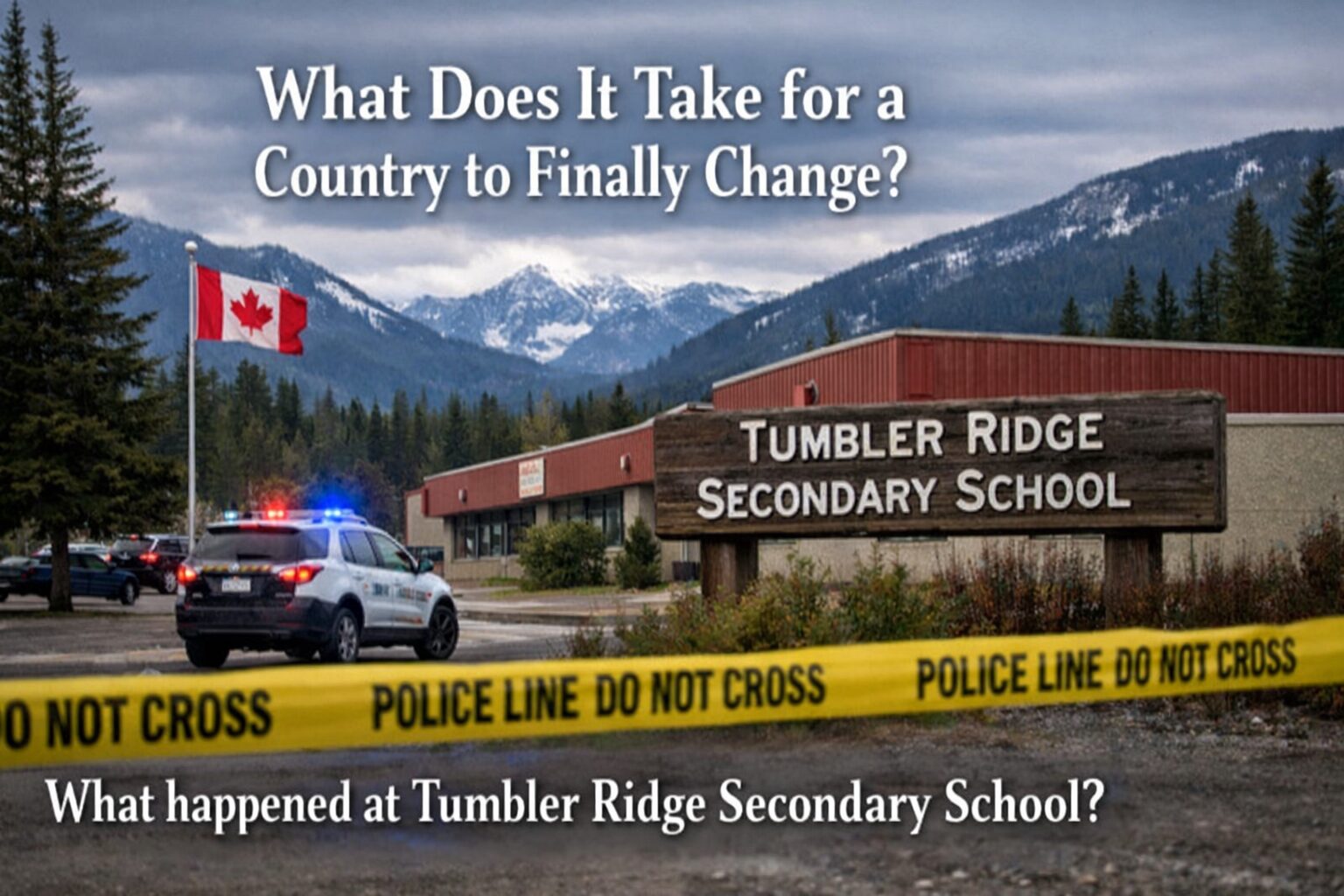
TUMBLER RIDGE, BRITISH COLUMBIA — The answer to that question is not nine.
But nine is what we have today.
Nine families setting tables for children who will not come home. Nine sets of parents trying to explain to younger siblings why big brother or big sister isn’t walking through the door. Nine obituaries to write before the bodies have even been identified.
And still, the question hangs in the cold mountain air: What will it take?
At 1:20 PM on what meteorologists had promised would be a beautiful afternoon, a shooter walked into Tumbler Ridge Secondary School. The building sits quietly at the edge of town, the kind of school where the principal knows every student’s name and the annual talent show is the biggest event of the year.
By 1:25, six people inside those walls were already dead.
A seventh died on the way to the hospital, racing toward help that arrived too late.
Two more victims were found at a residence across town — a “secondary location,” police called it, as if any of this could be secondary to anything.
The suspected shooter is also dead. Self-inflicted, police believe. A convenient ending for someone who didn’t have to face what he created.
Twenty-five others injured. Some airlifted. Some walking wounded. Some who will carry this day inside them for the next fifty years.
And now a town of 2,400 people — quiet, remote, the kind of place people move to get away from exactly this — has become the answer to a question no one wanted to ask: Where will it happen next?
Prime Minister Mark Carney said he was “devastated.”
Of course he was.
We are all devastated.
We were devastated after École Polytechnique in 1989, when fourteen women were murdered simply for being women studying engineering. We were devastated after Dawson College in 2006, after La Loche in 2016, after the Danforth in 2018, after Nova Scotia in 2020, after Saanich in 2022.
Devastation has become Canada’s most reliable national export. We produce it in abundance. We ship it to grieving communities with impressive efficiency. We are, by now, experts at devastation.
What we have not yet mastered is the part that comes after.
In Tumbler Ridge, they are still counting. Police are still searching additional homes, still knocking on doors, still trying to determine whether the full scope of this nightmare has even revealed itself yet. In a town this size, every knock carries the weight of potential catastrophe.
The Northern Rockies rise up around this community like silent witnesses. They have seen glaciers carve valleys and forests regrow after fire. They have seen this town survive the boom and bust cycles of coal mining, the economic uncertainty that comes with remote living, the quiet determination of people who choose to build lives far from cities and crowds.
They have never seen this.
There is a particular cruelty in school shootings that transcends even the horror of the act itself. Schools are not just buildings. They are where we send our children with the implicit promise that they will be safe. They are where future doctors and carpenters and mothers and fathers spend their days learning and laughing and occasionally complaining about homework.
When a school becomes a crime scene, that promise is broken. Not just for the families who lost someone, but for every family who will ever send a child through any school doors anywhere.
The students of Tumbler Ridge Secondary will graduate — if they graduate — knowing that their school is now a statistic. Their town is now a headline. Their memories are now evidence.
And Canada has added another entry to a list no one wanted to keep.
Here is what we know about Tumbler Ridge: It is home to prehistoric dinosaur tracks preserved in stone. Millions of years ago, creatures walked through this valley and left behind evidence of their existence. Today, paleontologists study those tracks, trying to understand what happened and why.
In the future, historians will study our tracks too. They will look at the pattern of shootings that have spread across this country with accelerating frequency. They will examine the parliamentary debates, the failed bills, the promises made and abandoned. They will ask how a nation with no shortage of resources and no lack of warning signs kept walking toward the same cliff, decade after decade.
What will they conclude?
That we were devastated. Repeatedly. Reliably. Devastated.
But not quite devastated enough.
The RCMP continues its investigation. The prime minister’s statement sits on the official record. Crisis counselors are being deployed. Flags will lower. Vigils will be held. Condolences will be offered.
And then what?
Tumbler Ridge did not ask to become a cautionary tale. The parents waiting for news at the community center did not volunteer to become symbols of gun violence. The first responders who walked into that school did not sign up to carry the weight of nine preventable deaths for the rest of their careers.
They are not asking for our thoughts and prayers. They are asking, through their silence and their tears and their incomprehension, a much simpler question:
Why did it have to happen here?
The more honest question — the one we keep refusing to ask — is this:
Why do we keep letting it happen anywhere?
Nine people are dead tonight in British Columbia. Two dozen more are injured. Hundreds are traumatized. A town of 2,400 has been permanently altered.
The mountains will still be there tomorrow. The school will eventually reopen. Life, as it does, will continue.
But nine families will never be the same. Nine chairs will remain empty. Nine stories that should have stretched into old age have been abruptly, violently terminated.
And a country that has become very good at mourning will once again ask itself the same question it has asked after every similar tragedy, every investigation, every heartbreaking headline:
What will it take?
The answer, apparently, is not yet nine.
But how many more will it be?


Leave an answer