
We Spent Millions Extraditing a Hungry Honduran for a 5-Year Fentanyl Sentence. Who Exactly Are We Punishing?
Question
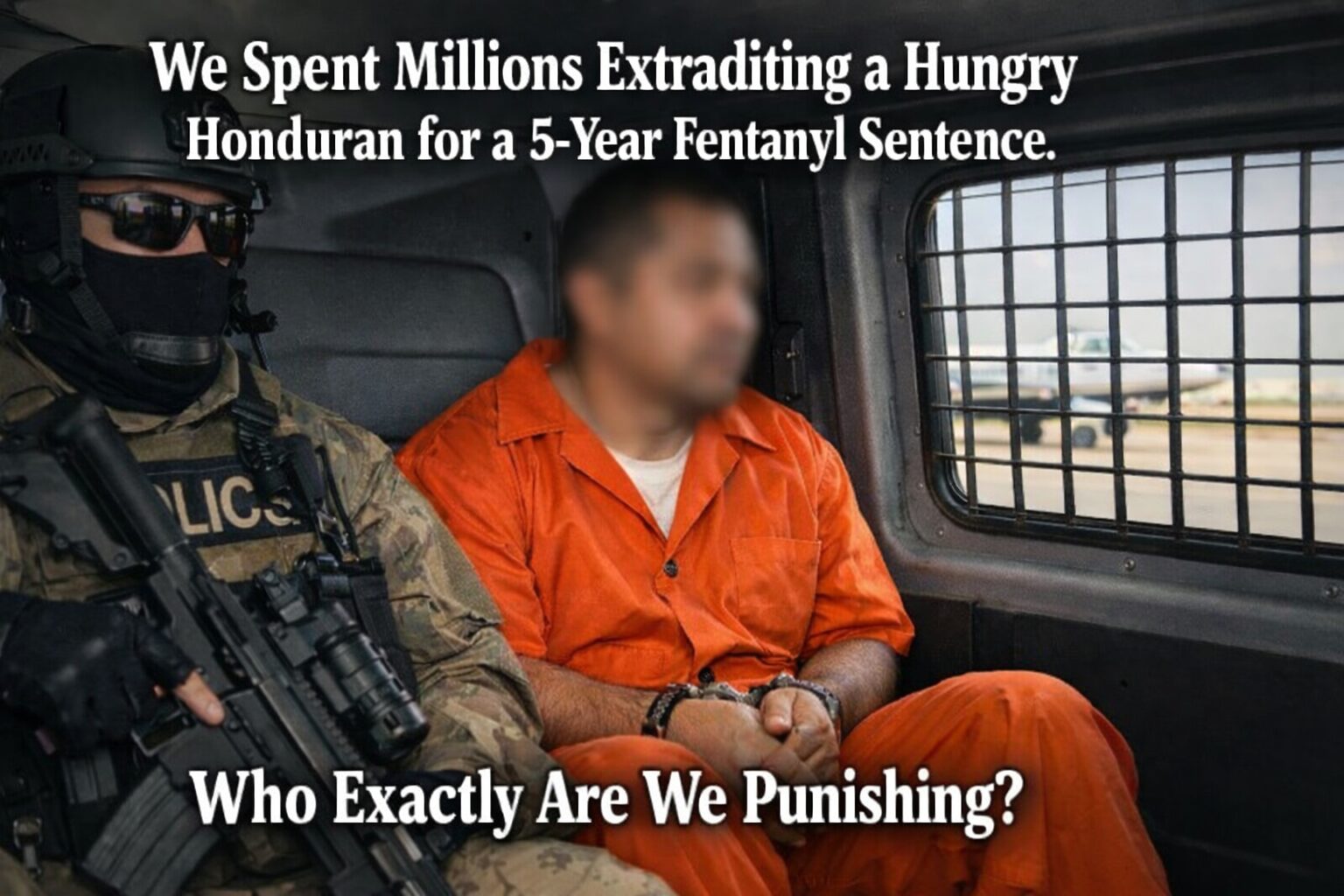
When Gustavo Erazo’s shackled flight landed in San Francisco last year, escorted by federal agents who’d spent months negotiating his return from a Honduran prison, one question hung heavier than the charges: Was this justice—or theater? The 44-year-old would soon learn his fate: five years behind bars for managing a Bay Area fentanyl depot. But as taxpayers foot the bill for an international manhunt, activists, cops, and grieving families are asking a more uncomfortable question: Why are we hunting down desperate men in foreign countries while the overdose crisis devours American cities whole?
What Does $350,000 Worth of Justice Actually Buy?
Let’s run the numbers. The extradition alone—diplomatic cables, liaison officers, chartered flights, Honduran police cooperation—likely cost over $100,000. Five years in federal prison? That’s another quarter-million in taxpayer money. The total sum to punish one man: roughly $350,000.
What did we get for it? A 140-pound former construction worker who started selling drugs when he couldn’t afford rent. Prosecutors admit he wasn’t a cartel boss—just a replaceable node in a network that spans continents. Within weeks of his 2022 arrest, new dealers filled the void in San Francisco’s Tenderloin district. The stash house he managed? It’s probably already been repurposed for the next operation.
So what exactly are we buying with this investment? A press release-worthy headline? A diplomatic trophy? Or genuine public safety?
How Does a 10-Year-Old Coffee Picker Become a Fentanyl Dealer?
Erazo’s origin story isn’t unique, which might be the most damning detail. Born into a dirt-floor hut in rural Honduras, he was picking coffee beans by age 10 while American kids learned multiplication. Hunger wasn’t abstract—it was days without food. At 12, he watched his older brother bleed out from a gunshot wound in the street.
“When you grow up like that, you learn survival trumps morality,” his defense attorney wrote. Erazo crossed into the U.S. illegally in 2000, spent two decades doing backbreaking construction work, and sent money home. But San Francisco’s rent crisis doesn’t care about hard work. When he couldn’t afford a room, he did what thousands before him have done: turned to the underground economy.
Is this an excuse? Federal prosecutor Kathryn A. Cardi doesn’t think so. “Every dealer has a tragedy,” she told the court. “Meanwhile, teenagers in Palo Alto are dying from pills traced back to these apartments.”
But here’s the question Cardi’s statement begs: If every dealer shares the same story, isn’t the story itself the crime scene?
Is 15 Pounds of Fentanyl Worth a 3,000-Mile Manhunt?
The DEA’s 2022 raid on the Berkeley apartment yielded a staggering haul: 15 pounds of fentanyl powder, equivalent to 3.4 million lethal doses. Agents found another pound and a half at Erazo’s Oakland residence. They seized $50,086 in cash—mostly from his co-defendant’s backpack.
Make no mistake: This was poison, and lots of it. Special Agent Wade R. Shannon called it “preventing a massacre.” But Erazo’s role remains murky. Prosecutors described him as a manager, but not the source. The suppliers—the actual manufacturers and importers—were never named in court filings. They remain faceless, borderless, untouchable.
So we chased the Honduran guy who fled because he couldn’t afford a lawyer, but the chemists who cooked the drugs and the financiers who bankrolled them are still at large. Is this winning the war, or playing whack-a-mole with the most vulnerable mole?
What If the Real Criminals Never See a Courtroom?
Erazo’s co-defendants—Melvin Diaz-Arteaga (78 months) and Luis Erazo-Centeno (56 months)—were sentenced last year. All three are now in federal custody. The operation is officially “dismantled.”
Yet San Francisco’s overdose rate dropped by only 7% in 2023. Fentanyl still kills two people daily in the city. The Tenderloin’s open-air markets operate like municipal services—24/7, rain or shine. DEA San Francisco has seized over a million pills this year alone, suggesting supply hasn’t slowed.
Here’s the question that makes prosecutors squirm: Are we incarcerating distributors while ignoring demand? America consumes 80% of the world’s opioids while representing 4% of its population. No amount of extradited Hondurans will change that arithmetic.
Can You Blame Poverty for a Public Health Catastrophe?
Erazo’s attorney handed the court a poverty report disguised as a sentencing memo. It worked—sort of. Judge Charles Breyer acknowledged the “truly difficult upbringing” but emphasized the “extraordinary danger” of the crime.
In his pre-sentence interview, Erazo himself seemed confused by the narrative: “When you do things you know aren’t right, it’s not because you want to do something bad. It’s just necessity. I didn’t have a place to live. I wish I’d been able to do something else for money.”
This is where the internet erupts. Progressives see systemic failure. Conservatives see personal responsibility. The families of overdose victims see excuses.
But what if both things are true? What if the system is broken and individual choices matter? What if chasing poor immigrants through foreign prisons is easier than fixing either?
What’s the Real Cost We’re Not Calculating?
The $350,000 price tag covers extradition and incarceration. It doesn’t cover:
- The Honduran family Erazo can no longer support
- The next dealer already recruited to replace him
- The diplomatic capital spent on a low-level case
- The public trust eroded when headlines about “international fentanyl traffickers” obscure the reality of a broke construction worker
Most importantly, it doesn’t cover treatment. Every dollar spent on incarceration is a dollar not spent on the 8,000 Bay Area residents currently waitlisted for publicly funded rehab. The National Institute on Drug Abuse calculates that every $1 invested in treatment saves $12 in criminal justice costs.
So here’s the final question: If we can afford to hunt a man across international borders for a five-year sentence, why can’t we afford to treat the addiction that created his job in the first place?
Erazo’s plane took off from Honduras with one man in chains. Until we answer that question, the war on drugs remains a war on symptoms—not the disease.


Leave an answer