
The Rising Ocean’s Silent Migration
Question
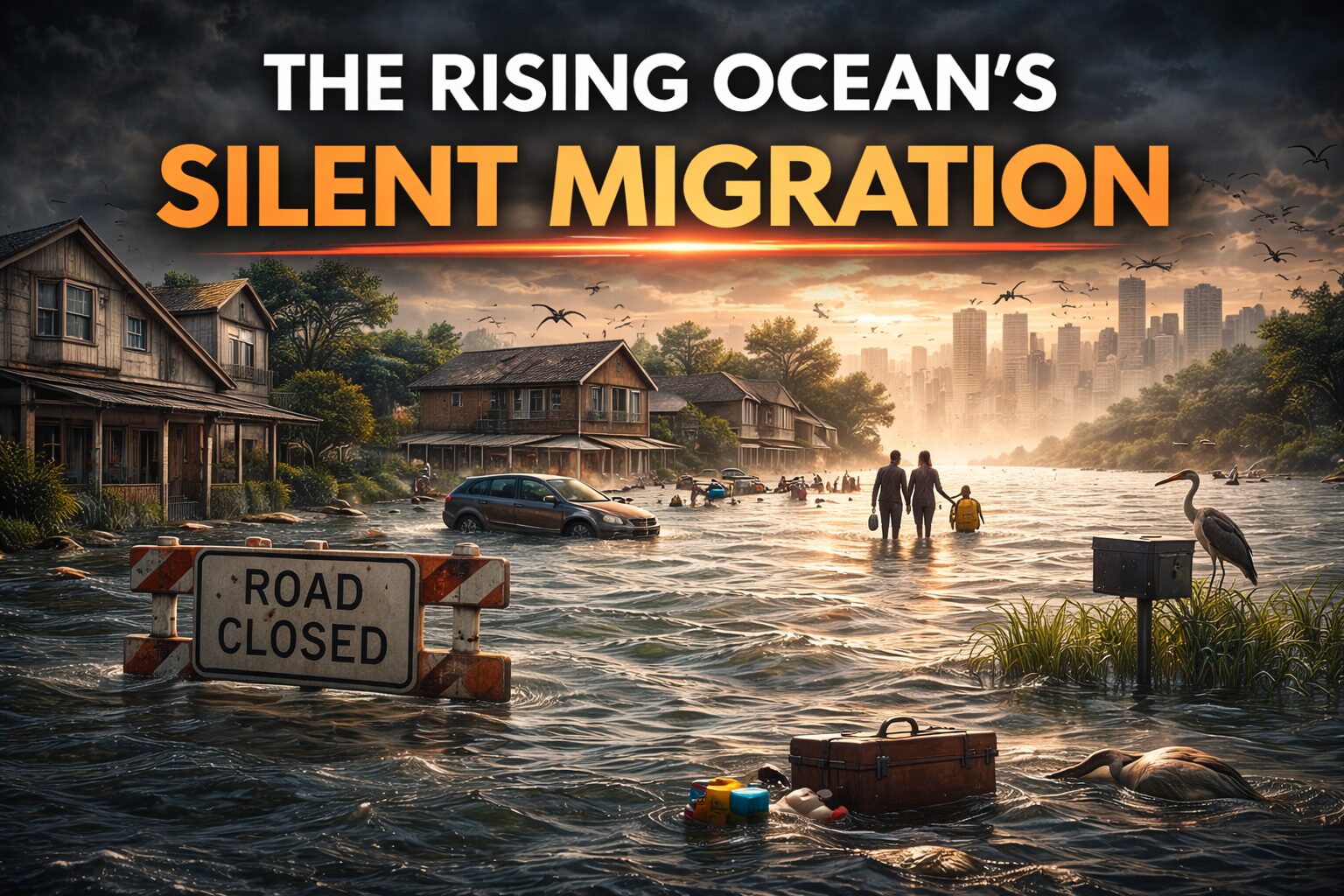
What happens when the water comes for our cities?
The maps of human habitation are being redrawn by forces that move too slowly for daily news cycles but too quickly for geological time. Revised scientific assessments suggest that sea level rise threatens tens of millions more people than previously understood, compressing the timeline for coastal adaptation from centuries to decades.
The new projections incorporate improved understanding of ice sheet dynamics—how the massive glaciers of Greenland and Antarctica respond to warming air and water. Previous models treated these ice masses as relatively stable, melting gradually from the edges inward. Current research suggests more dramatic possibilities: ice shelves collapsing suddenly, glaciers accelerating their slide toward the ocean, meltwater lubricating the interface between rock and ice. Each mechanism adds volume to the oceans faster than linear projections anticipated.
The human geography of vulnerability is uneven. Wealthy coastal cities—Miami, New York, Shanghai, Rotterdam—have resources for elaborate defense systems, elevated infrastructure, and managed retreat. They will spend billions to hold back the water for decades, perhaps generations. Poorer coastal communities lack these options. Their adaptation strategies involve migration, the abandonment of ancestral lands, and the dissolution of communities built over generations.
The insurance industry has already begun recalibrating. Coastal property coverage becomes prohibitively expensive or simply unavailable, creating a secondary market of uninsurable assets. Property values in vulnerable zones plateau or decline as buyers factor in future risk. Municipal bonds for coastal infrastructure projects face skepticism from investors questioning whether the projects will outlast their financing.
The political challenge exceeds the engineering challenge. Democracies struggle to mobilize resources for problems that exceed electoral cycles. The benefits of coastal defense spending accrue decades in the future; the costs are immediate and visible. Meanwhile, the displaced populations of today—whether from storm damage or gradual inundation—demand immediate assistance that competes for budgetary attention with long-term prevention.
The ocean’s rise is not a future hypothetical. It is measured in millimeters per year, in nuisance flooding that closes roads during high tides, in saltwater intrusion that contaminates freshwater aquifers. These incremental changes accumulate into transformative forces that will reshape where and how humanity lives along the planet’s edges.


Leave an answer