
Did Justice Finally Find Closure? The Execution of Harold Wayne Nichols in Tennessee Raises Critical Questions
Question
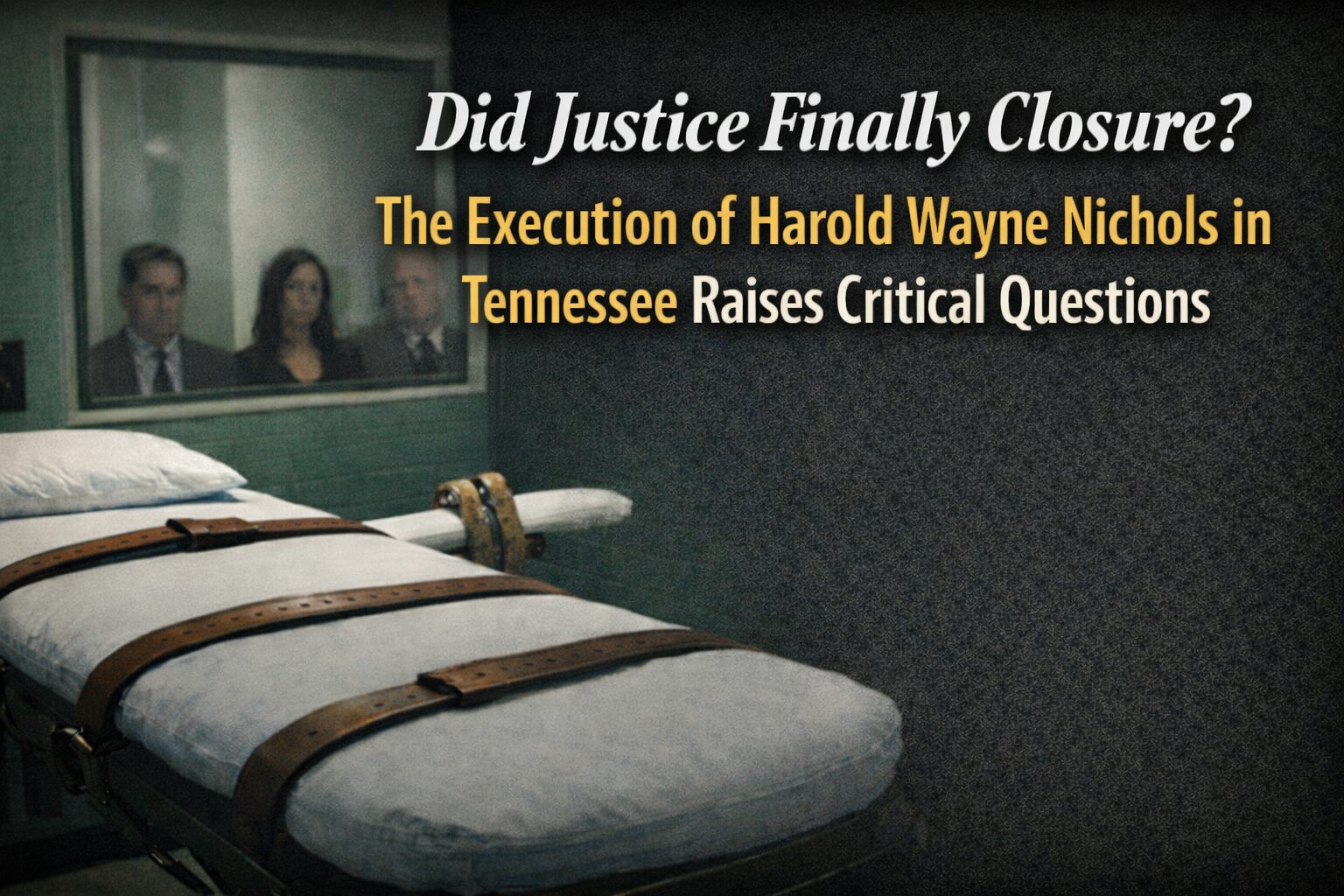
In a moment that has reverberated across the nation, Harold Wayne Nichols, a 64-year-old serial rapist, was executed by lethal injection in Nashville, Tennessee, on Thursday. The execution was for the brutal 1988 rape and murder of Karen Pulley, a 20-year-old Chattanooga State student. But as the curtain falls on this decades-long saga, numerous questions linger, prompting a deeper examination of justice, remorse, and the death penalty.
Was the Execution the Right Course of Action?
Nichols, who confessed to Pulley’s murder and multiple other rapes in the Chattanooga area, had been sentenced to death in 1990. Despite expressing remorse during his trial and admitting that he would have continued his violent behavior if not apprehended, his fate was sealed. But does an execution truly serve justice, or does it perpetuate a cycle of violence?
In his final statement, Nichols offered a simple but profound apology: “To the people I’ve harmed, I’m sorry.” Accompanied by spiritual adviser J.R. Davis, who prayed with him in the execution chamber, Nichols appeared to find some solace in his final moments. This raises the question: Can remorse and spiritual transformation be genuine, and should they be considered in the context of capital punishment?
How Did the Execution Impact the Victims’ Families?
For Karen Pulley’s family, the execution brought a mix of emotions. Pulley’s sister, Lisette Monroe, had wanted to be present but became too overwhelmed. Her husband and Pulley’s brother-in-law, Jeff Monroe, read a statement on her behalf, saying the family “was destroyed by evil” the night Pulley was killed.
Jeff Monroe emphasized that while taking a life is serious and they take no pleasure in it, the crimes committed were deliberate, violent, and horrific. Lisette Monroe, in a recent interview, described the wait for Nichols’ execution as “37 years of hell.” She remembered her sister as gentle, sweet, and innocent, and hoped that after the execution, she could focus on the happy memories of Pulley instead of her murder.
But does an execution truly provide closure for the families of victims? Or does it reopen old wounds and prolong the pain?
What About the Legal and Ethical Implications?
Nichols’ attorneys had unsuccessfully sought to have his sentence commuted to life in prison, citing his acceptance of responsibility and guilty plea. They argued that he would be the first person executed for a crime he pleaded guilty to since Tennessee re-enacted the death penalty in 1978. The U.S. Supreme Court’s decision to decline a stay of execution on Thursday further complicates the legal landscape.
Moreover, the execution comes at a time when many states are struggling to obtain lethal injection drugs due to pressure from anti-death penalty activists on drug companies and other suppliers. Between shortages and legal challenges over botched executions, some states have moved to alternative methods, including a firing squad in South Carolina and nitrogen gas in Alabama.
This raises ethical questions about the methods of execution and whether they align with societal values. Should the state be allowed to take a life, and if so, under what circumstances and by what means?
Can Redemption Coexist with Capital Punishment?
J.R. Davis, who had known Nichols for a decade as part of a prison men’s group, believed that Nichols’ remorse and spiritual transformation were genuine. He said, “Nichols committed horrible crimes. But killing to teach people not to kill just doesn’t make sense.”
Nichols’ attorney, Debbie Drew, echoed this sentiment, saying her client had turned his life over to God after speaking to Pulley’s mother decades ago, shortly after he was sentenced. She criticized the execution, saying it “sent the message that no one can rise beyond the crimes they committed decades earlier and that redemption deserves no mercy.”
This raises the question: Can individuals truly find redemption after committing heinous crimes, and should society be willing to offer them a second chance? Or is the death penalty the only way to ensure that such crimes are not repeated?
Including Nichols, a total of 46 men have died by court-ordered execution this year in the U.S., marking a significant moment in the ongoing debate over capital punishment. As the nation grapples with these complex questions, one thing is clear: the execution of Harold Wayne Nichols has left an indelible mark on the landscape of justice, prompting us to reflect on the true meaning of closure, remorse, and redemption.


Leave an answer